Daily update e-mails are suspended until further notice.
Mark Colombo
Though the majority of the people here who would know me under the pseudonym Trip Ericson, my real name is Mark Colombo. As of this writing, I'm a 36-year old graduate of the University of Virginia in Charlottesville who is Associate Chief of the Video Division at the Federal Communications Commission. From November 2011 to February 2013, I worked for Luken Communications, parent company of Retro TV, Heartland, and other television networks. From March 2013 to September 2019, I worked in the FCC's Office of Engineering and Technology, where I earned the Excellence in Engineering award in 2015, was a 2017 FCC Employee of the Year, and was on the team that earned an Emmy in 2024 for its work on the Incentive Auction and repack. There, I managed the development of the FCC's TVStudy software, used for calculating interference between stations during and after the Incentive Auction and repack, a task I continue to perform since moving to the Video Division. I earned the 2024 E. Noel Luddy Award from AFCCE. I hold a B.S. in Electrical Engineering and a minor in Engineering Business, and I received the Society of Broadcast Engineers' Youth Scholarship in 2007 as well as two scholarships from the Association of Federal Communications Consulting Engineers. I have an interest in broadcasting and computers, am an A+ and Network+ certified computer technician and I'm a full-time Ubuntu Linux user. I am a licensed Extra-class ham radio operator, with the callsign N4MJC. In what spare time I have, I play Pokemon video games, read up on etymology and linguistics, and map the locations of cell phone towers.
Bruce Myers
Bruce Myers is a software engineer from the Grand Rapids, Michigan area, and he is the wizard behind the coding on RabbitEars. He approached me in an e-mail on March 14, 2008 in response to my message on the front page seeking someone to help me out. He is a software engineer who has been coding since 1985, and has experience in Java, C++, HTML, JavaScript, and PHP. Without him, RabbitEars would still be just a dream.
Dave Hettesheimer
Dave, known online as dhett, is a software developer with the State of Arizona and a monthly contributor to RabbitEars, documenting activity from stations located in, or broadcasting into, Arizona. Dave's interest in television dates back to the 1980s, receiving Western New York and Canadian stations with a set of rabbit ears, but after moving to the Phoenix area in the mid-1990s, became interested in Arizona television after seeing a list of translators in the Phoenix edition of TV Guide and discovering that Arizona had over 200 licensed television stations. He has been publishing his monthly roundup of Arizona station activity on RabbitEars since 2010 and enjoys collecting television signals, especially those of translator and low-power stations.
James Thomas
Jim resides in Springfield, Missouri and is a TV and radio research enthusiast. He is semi-retired from the graphic arts industry. He was educated and trained through a 3M Corporation mentorship program in the 80s, which involved all aspects of fleet vehicle marking and branding programs, and went on to work at five different 3M outlet locations in the Rocky Mountain west. An outgrowth from the graphics training led to publishing a variety of books covering topics on radio: Sports Radio, The Guide (a directory for collegiate and professional sports team radio networks); The Mexican Radio Directory (a radio guide to Mexican FM radio stations); and Emisoras de FM (a guide published annually for three years, covering licensed FM facilities in Mexico, Central America, and the Caribbean islands). As a current member of the Board of Directors of the Worldwide TV-FM DX Association (WTFDA), he is involved as an editor for the WTFDA Database of FM Radio Stations, where his areas of responsibility are Mexico, Central America, and the Caribbean. In 2011, he began to develop an interest in DTV broadcasting and operations and has now received over 200 DTV stations from over 20 states from his home. His current passion is researching DTV facilities and collecting TS Reader data, for his own collection and that of updating RabbitEars.
Mike Mahan
Better known as Falcon_77 on AVS Forum, is the "keeper of the spreadsheet" listing the DTV channels that are available by area in a form that provides a quick synopsis of available channels. Mike is a graduate of the University of San Diego (1996) and holds a BS/BA degree in Electrical Engineering. In addition to putting several hours per week into the US DTV spreadsheet, Mike also runs Radio Mobile simulations for digital television stations broadcasting in both the US and UK. He is a General-class ham radio operator, with the callsign K6MSM.
Garrett Vrieze
As of this writing, Garrett is a 30-year old telecom expert working as a networking/telecom/IT field service staff contractor for a Fortune 500 airline. He has broad interests in many subjects and has always been interested in the broadcasting scene. He enjoys traveling the United State's West Coast, Mexico, and Canada and getting TSreader data for RabbitEars and taking pictures of broadcast towers during numerous personal and professional travel. He is a full time Ubuntu Linux user as well as a licensed General-class ham radio operator, with the callsign K0GJV and known around the net by handle gjvrieze.
Bob Nelson
A former radio broadcaster (on air at KAAY/Little Rock, WSIX/Nashville, WPNT-WLTJ/Pittsburgh and KQZY-KRSR/Dallas), since 1991 Bob has been a software designer, writer and maintainer for On Air Digital in Dallas, a division of SMARTS Broadcast Systems, a provider of radio automation and traffic systems specializing in small markets. His primary languages are C, C++, Perl, PHP, JavaScript and the family of shell tools (awk, sed, the grep sisters and such). Bob has been a Linux user since 1992 and only became acquainted with Microsoft Windows in 1999. A former Unix instructor at North Lake College in Irving, TX, Bob's contribution to RabbitEars is assisting with automating the Longley-Rice coverage maps.
If you wish to submit "Historical and Ownership Data" or simple subchannel information you will want to just send me an e-mail at the address on my Contact page with that information in it. I'll parse it and load it in by myself. I should warn you though, I can't promise I'll get to it quickly. My priorities are with the technical data, as this is what interests me the most. If I have a lot to do, such updates will very likely have to wait. I get on Ownership and subchannel changes pretty quickly, but historical information, not so much.
If you wish to submit "Technical Data" you will need a bit more information. First of all, any data about facilities comes from the FCC site or from my own handy work if it's something that doesn't appear there. Most of the time, this will be as accurate as I can make it. But do let me know in case it's something I can deal with.
If you wish to submit the other technical details about subchannels, I request that you send me output from the TSReader program in a zipped e-mail attachment to the address on the Contact page. You can acquire that here (TSReader Lite will work fine) and once you lock in the station with that program, do an HTML Export, selecting all the checkboxes except for Thumbnails and EIT.
If you want to determine whether or not a station is doing variable bitrate encoding, watch for the bitrates on the video streams in TSReader to vary by large amounts (greater than 0.1 Mbps) and if they do, that station is likely doing variable bitrate encoding. You can send that detail in the text of an e-mail if you wish.
Please note that a friend of mine is working on software that will produce similar output to TSReader but in a cross-platform and more convenient fashion. It is not currently available to the public, but you may note that I have updates that are more recent than the associated TSReader data because one of the beta testers has sent me data from this new software instead.
Q. What does READS stand for?
RabbitEars Area Designation System.
Q. Why does READS exist? Why not use the Nielsen DMA rankings?
In 2008, Nielsen sent a cease and desist notice to Wikipedia over its use of the Nielsen DMA system. It was at that time that the determination was made to discontinue use of the Nielsen ranking system on RabbitEars and instead generate a solution.
Q. How does READS rank markets?
I use Census data to figure the population, and then OTA coverage to determine markets. In places without full-service station coverage, translators in the area are used to make a market determination. If two sets of stations overlap, the one with stronger coverage is used. If it's equal, the larger ones are used. Now this is not universal yet; an automated script used distance to the nearest TV station to create the initial ranks, which should later be tweaked to match the aforementioned conditions. However, this is a time-consuming process and thus many of the markets are still based on the automated system for the time being. Hopefully, eventually, all the markets will be corrected.
Q. Who can use READS?
Reads uses publicly-available Census data along with publicly-available coverage data to determine market sizes. As such, READS is free to use by anyone. However, if you should modify the rankings in some way, please do not use the READS name. Only use the READS name if the rankings match the ones used on RabbitEars exactly.
Q. What do the DT-LIC, DX-CP, etc. all mean?
The first two letters identify the station type, and the second identify its status. DT is full-service Digital Television, DS is a Digital STA (Special Temporary Authority), DX is Digital auXiliary, DC is Digital Class A, LD is Low-powered Digital. As for status, LIC is licensed, CP is Construction Permit, APP is an APPlication for a construction permit, and an STA is special temporary authority to operate with the specified facilities without a license for those facilities, often used in cases of tower collapse and other unforseen events.
Q. Is there an easy way to determine what something means in the main listings?
Many of the terms and abbreviations on the main listings page have information encoded about what they mean. Simply hover over the term and for most items, you should receive a simple label with information on the meaning of that particular term or acronym.
Q. Where can I find information on the digital transition?
DTVAnswers.Com has a decent amount of information on the subject. I would do an FAQ for it here, except that it's already stated on other sites and stated well; there is no need for me to waste time doing a repeat of what is already available.
Before I begin, make sure you don't miss the important questions about Zones, channels 14-20, LP and CA stations, and channels 2-6 later in this FAQ.
Q. How are these available channels calculated?
Essentially, the FCC mandates that stations keep a minimum distance between themselves and other stations. Rather than calculating field strength, as was done during the digital transition to try to fit all the stations in while ignoring this distance separation, new stations, are required to follow these spacing requirements. What RabbitEars does is measure the distance to each station and use that along with the following numbers to calculate whether or not a station fits according to the spacing requirements. These are the measurements used:
Zone I, VHF: Stations must be 152 miles apart on the same channel, and less than 12.43 or greater than 68.35 miles apart on the adjacent channels.
Zone I, UHF: Stations must be 122 miles apart on the same channel, and less than 14.91 or greater than 68.35 miles apart on the adjacent channels.
Zones II and III, VHF: Stations must be 170 miles apart on the same channel, and less than 14.29 or greater than 68.35 miles apart on the adjacent channels.
Zones II and III, UHF: Stations must be 139 miles apart on the same channel, and less than 14.91 or greater than 68.35 miles apart on the adjacent channels.
Q. What are "Zones" and where are they located?
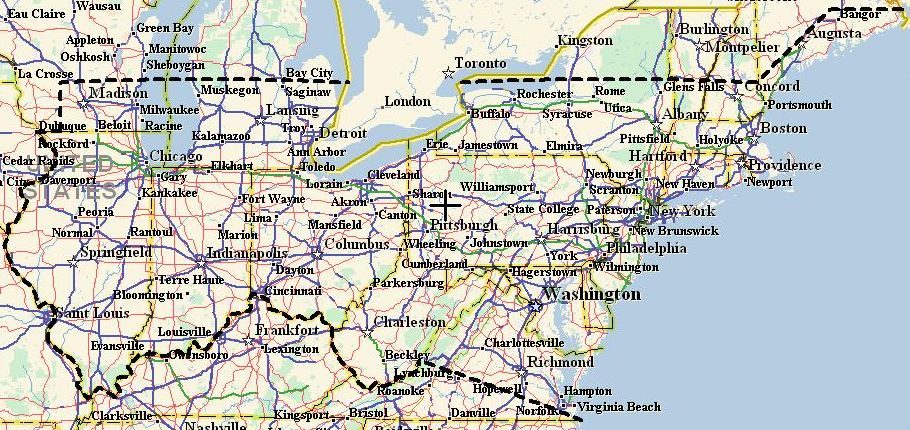
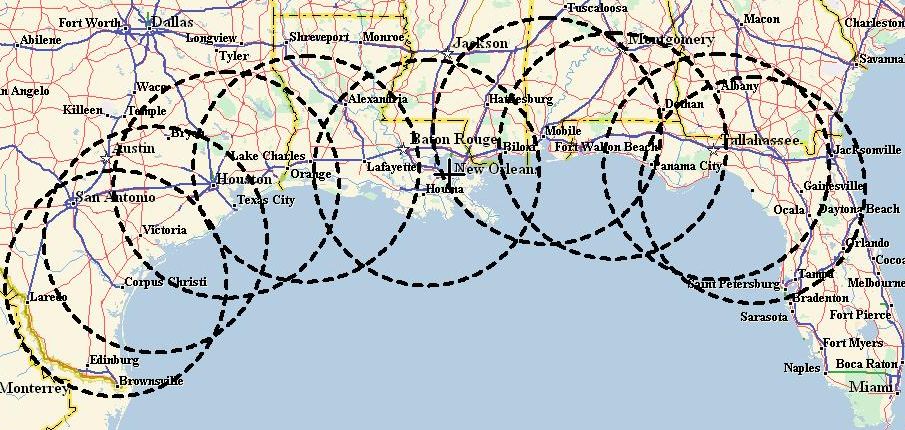
The FCC divided the country into several "zones" in order to allow stations in the Northeast and Great Lakes region with smaller coverage areas to be spaced closer together, and to try to alleviate interference concerns around the Gulf of Mexico. The FCC seems to have decided that Zones II and III are equivalent as far as digital television is concerned, but Zone I still has stronger limitations on signal strength and, consequently, can fit more stations in a given area. I've created maps of the Zones here:
Zone I consists of all the states and portions of states enclosed by the dotted black line.
Zone III consists of all the states and portions of states enclosed by the dotted black circles, including the entire state of Florida.
Zone II consists of any areas that are not in Zones I or III.
When measuring for available stations, if either your location or the station being measured is in Zone I, the Zone I measurement is used. So if I am in Zone II and I am attempting to measure to a station in Zone I, I measure as though both are in Zone I. But when measuring my Zone II location against another Zone II station, I use the Zone II measurement.
Q. When I do a search, I get stations on channels 14-20 which have call signs beginning with "LM." What are these and how do I handle them?
The FCC has reserved one or more channels in the 14-20 range in several large cities for use by local police and emergency officials. These are shown in the FCC rules as reserved for Land Mobile use only, thus the "LM" indicator.
It is important to note that these reserved frequencies DO NOT conform to the same requirements as digital TV stations do, and must be computed separately. Here are the requirements:
Co-Channel Operation: No stations are to transmit on the same channel as a Land Mobile operation within 155 miles of the given coordinates.
Adjacent Channels: No stations are to transmit on the adjacent channels of a Land Mobile operation within 109.36 miles of the given coordinates.
The FCC seems to have ignored its own rules with regard to some of these reserved channels, but all new stations must conform to these requirements.
Q. How are low-powered and Class A stations handled in all of this?
Low-powered stations are in gray text and can be ignored for the purposes of the available channel search. Low-powered stations receive no protection from encroachment of full-powered stations, and if a full-powered station wants their frequency, they are required to move.
Class A stations, however, do receive such protection. Exactly what protection they receive is unclear to me as of this writing, but they are measured in the table as though they are full-service, and if only a Class A station prevents a station from being listed as "Available," it is listed anyway with an asterisk (*) placed beside it. Further measurements beyond the scope of this search would likely be required.
Q. Why are there so few stations on channels 2-6?
Channels 2-6 have some severe problems which can be tolerated in the analog world, but cause havoc in the digital world. Chief among these is that electrical noise from lightning as well as vacuum cleaners, blenders, and anything else with an electric motor, can and will cause the signal to drop out or disappear completely.
These channels also suffer from a phenomenon called "e-skip" which is when ions in the E-layer of the ionosphere create a sort of mirror which reflects signals that would otherwise go out to space back down to Earth. This allows stations from as far as 1500 miles away to interfere with what you are attempting to watch.
While the power saved by using these channels is undeniably great, the tradeoffs are huge. It is advised to avoid these channels if at all possible.