
This is an old revision of the document!
Adjacent-Channel Interference
When considering adjacent-channel interference with respect to station facilities and channel assignments, there isn't a distance requirement with respect to other stations, there's a population impacted requirement, which makes it hard to generalize. To understand it, it's worth taking a step back to understand how adjacent-channel interference works with digital TV.

In this picture, you can see a hypothetical spectrum analyzer plot for the situation in question. Station A in the center is the station we want to receive, while stations B and C on the lower and upper adjacents are the interfering station. You can see that A is 25-30 dB weaker than B and C. So the question is, can station A decode?
The answer is, maybe. By FCC rules, probably not. The FCC's OET Bulletin No. 69 specifies the ratios that are used for predicting interference, and it specifies -26 dB on the lower adjacent and -28 dB on the upper adjacent. So for our purposes, the FCC would likely predict interference here.
However, in practice, the ATSC A/74 Recommended Practice document sets a -33 dB threshold on both the lower and upper adjacent. In testing conducted by the FCC in 2007, the worst-case receivers were just shy of that at about -32 dB. So in practice, a typical receiver would probably receive this signal. This is by design; the ATSC purposely tried to set the standard about 6 dB better than FCC requirements in order to provide a bit of margin before the signal starts to become unreliable.
What's happening here is that the stronger adjacent channel signal gets too much stronger than the desired signal, the receiver starts to lose the ability to separate the two in order to decode the weaker one. Sort of like if someone's whispering next to you while someone else shouts on a megaphone nearby. If the megaphone is pretty far away just that it's relatively quiet, you'll probably still hear the person whispering. But as the megaphone gets closer, there's a point where you start to have problems hearing the person whispering, until they're finally drowned out entirely.
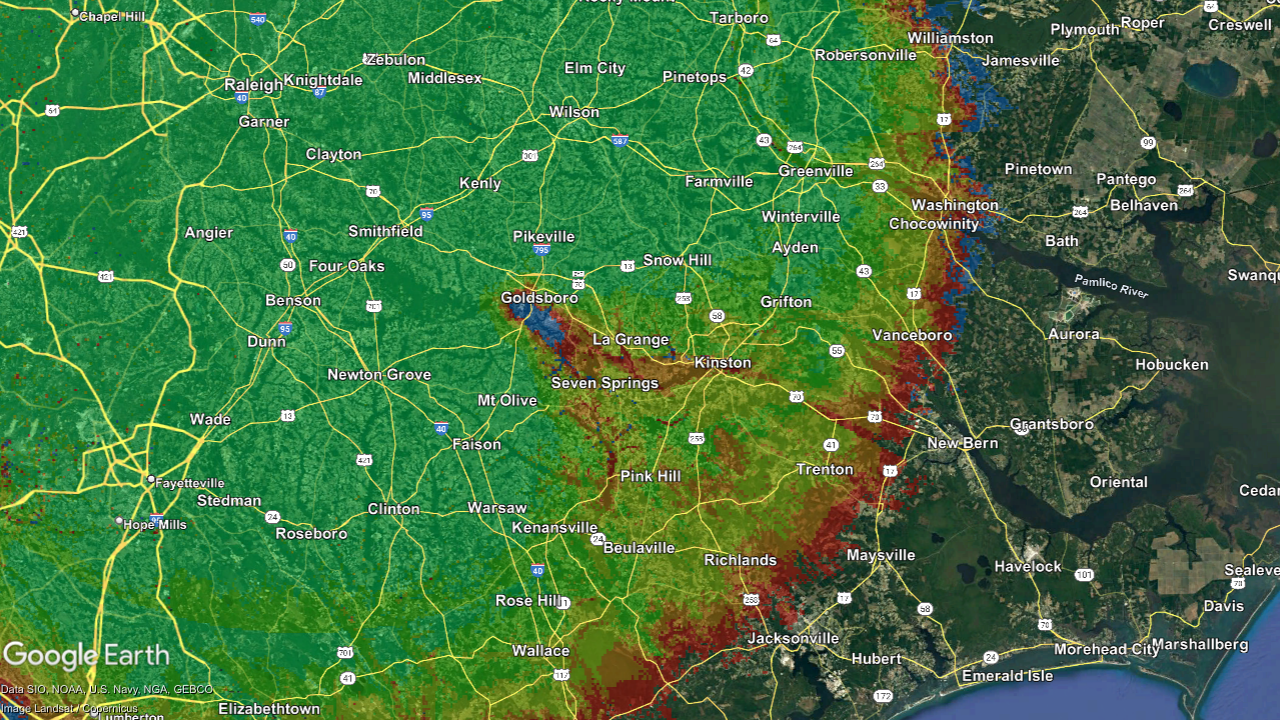
In any event, when the FCC is trying to determine whether or not a station is allowed to exist on an adjacent channel, it does this analysis across a geographic area using the methodology in OET Bulletin No. 69, using the TVStudy software. The FCC breaks the coverage area of the impacted station into a grid, and each cell of the grid has a representative point where a calculation is done of the signals in question. If the undesired signal exceeds the threshold with respect to the desired signal, that cell is flagged as having interference.
Above is a map I made back in 2018, which you can click to expand to its full size. I used unusual options in TVStudy to create a highly-detailed map, so while the FCC only permits a cell size down to 0.5 km on a side, I used 0.1 km on a side. The desired station here is WNCN on channel 8. The purple areas are those where WNCN is predicted to receive interference. You can see a pretty distinct interference area just south of Goldsboro; these are cells impacted specifically by adjacent-channel interference from WHFL-CD on channel 7.
Once the analysis of each cell is complete, the population of the flagged cells is added together and divided by the total prior interference-free population. If the impacted station is a full-service or Class A station, then that number cannot exceed 0.5%. If it's an LPTV or translator, it cannot exceed 2%. Stations can negotiate and sign an interference agreement to accept interference in excess of those values, but they can also opt not to negotiate and those FCC-set limits hold.